The Ephemerality of Relationships

Photo by Normal Rockwell via prints.nrm.org/detail/261030/rockwell-breaking-home-ties-1954
An unchangeable and painful aspect of human life is the temporariness of the relationships we hold. To throw around an overused biblical quote, all things must pass.
From the day we are born we are thrust into an already hardened cycle of existence, one that has been predetermined by those before us. Typically, we are born, acquire language, learn how to learn (schooling), assume a role/job within society, marry, have children, retire and die.
Whilst the rigidity of the cycle has eased in recent years, the majority of people are bound by the various societal and cultural effects of it, effects that can permeate and influence many of the decisions we make. Not sure what to do with your life? Go to University. Feeling lonely? Get married. You want free time? Retire early. As we pass through this cycle, our relationships are repeatedly warped and broken.
As a University student on the (naive) cusp of independence, the ephemerality of the filial relationship has recently been a subject of contemplation. Over the past three years of University life, I have steadily but surely drifted away from my parents. Biweekly visits became monthly visits became bimonthly visits became ‘I’ll visit when I’m free’. I couldn’t help but feel an unsettling emotional distance, as if my grand conception of my parents was fading away.
Whilst it may seem recent to me, this dissipation started when I began to realise my parents are not omnipotent, and that the chaos and danger of adult life is likely beyond their protection. When we begin to assume responsibility for our lives in the quest for independence, the transformation of the filial relationship reaches its final stages. This period of time can be a hotbed for emotional intensity and conflict, and is frequently explored by art.
No-one captures the poignancy of these emotional transitions better than Yasujiro Ozu in his captivating Noriko Trilogy. Throughout the trilogy (and much of his middle career) Ozu uses his masterfully refined minimalistic style to explore themes such as marriage, family, intergenerational gaps and existential transience.
Arguably the most compelling of the trilogy is his 1953 masterpiece Tokyo Story. The plot follows an elderly couple visiting their successful children. Whilst projected as a joyful experience for the parents, their children view the visit as a disruptive chore. As a result the couple are consistently neglected by all except their daughter-in-law, Noriko.
The plot is deceptively simplistic, and Ozu uses his characteristically natural and indigenous style to observe the characters in their ordinary lives and force the audience to lean into the piece. Whilst objectively slow in comparison to the extravaganza of modern Hollywood, Ozu perfectly paces his cuts in rhythmic succession, the result of decades of refinement and a testament to his brevity. The outcome is a mesmerising, almost hypnotic viewing experience that leaves the audience with raw, unexploited emotion.
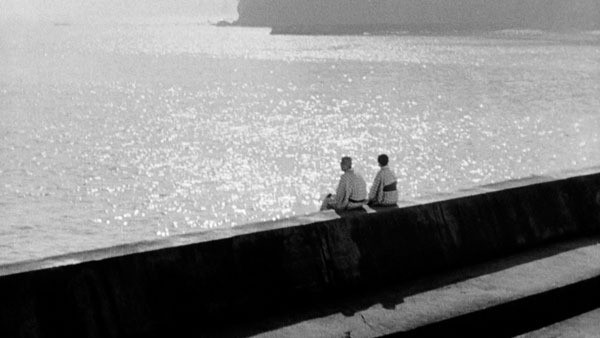
The elderly couple quietly contemplate their children. Tokyo Story (1953)
By immersing us in normality, Ozu allows us to relate to his characters with deeper sentiment. I was particularly struck by my various parallels with Koichi, a local doctor in Tokyo and one of two sons in the family. His obsession with work, exceedingly practical judgement and general disconnect to his parents is something that I have felt to a lesser degree, and the movie provided a means for me to explore and reflect upon this.
Throughout the main body of the film, Ozu chooses to withhold significant emotional displays or any obvious narrative cues. This is a characteristic of his transcendental methodology. As renowned critic Paul Schrader puts it, his style ‘heightens the mundane’ and ‘creates a sense of unease the viewer must resolve.’ The resolution of this feeling can be characterised as transcendence.
“Nothing, apparently, has prepared for the emotional depth of the last scene, yet it is a perfectly natural climax towards which the whole film has been moving.”
Milne p 183
Akin to the rest of the Noriko Trilogy, the coda of Tokyo Story is remarkably powerful. Having recently lost his wife, the father in the story enters a state of grief, and is comforted by Noriko. Finally, the intergenerational gap is bridged by a state of being synonymous to all: sorrow and suffering.

Noriko and her father-in-law share a moment of solace. Tokyo Story (1953)
Despite our knowledge of these cycles and patterns, for the most part there is little we can do to prevent the inevitable from ensuing. Whilst conformity, routine and regularity of any kind is deeply against my nature, intense resistance against the wheel of life is, in my opinion, futile. Furthermore, societal pressure to conform can be intense.
Rarely does a piece of cinema result in a lasting shift in the frame in which I view my life. The Noriko Trilogy has helped to quell some of my internal issues. Ozu’s films do not do this in an overly intentional and targeted way, but instead provide the means for us to derive our own layers of meaning from his work.
I have learnt to see the transfer of power and independence in my own parental relationship as a natural phenomenon, rather than as a result of excess coldness or practicality on my part. Ultimately, one must venture out into the world and carve their own path.
Relationships may be distorted, sorrow is inevitable, but the cycle continues nevertheless.
References
Tom Milne, ‘Flavour of Green Tea over Rice’, Sight and Sound vol. 32, no. 4 (Autumn 1963): p. 183.
Schrader, P., n.d. Transcendental Style in Film.
Transcendental Style in Film | Paul Schrader | TIFF 2017
Also available on Substack.