The Dark Beauty of Illusion

La Belle Dame sans Merci (1901) Sir Frank Dicksee
As a species, we are distinct in our tendency to dream or engage in illusions. As children we engage in elaborate play, and as adults we wilfully suspend disbelief to watch a movie or read a novel. Humanity’s most sublime art is created by people with the remarkable capacity to dream.
As the foremost Russian novelist, Dostoyevsky is no stranger to our rich potential for narrative creation, and the curses that accompany this. In White Nights, his anonymous character ‘The Dreamer’, is an individual who’s fantasies become hyperdeveloped and pathological. Socially isolated, he spends his life reading sentimental novels. One day he meets a lonely and upset young woman, Nastenka, lamenting her absent and estranged fiancée. After introducing himself, our Dreamer vows to help her win him back. Instead, he falls helplessly in love with her over the next three days, and she seemingly reciprocates. This naïve love spirals towards a tragic crescendo in which the dreamers’ prospects of bliss are shattered by the return of her fiancée.
During his brief romance our dreamer realizes the poverty of his dreamworld and the comparative richness and depth of real life. We are left to wonder whether ignorance was bliss as he seems paralysed by the depth and potency of reality. As a romantic dreamer, he has failed to stay detached (1).
“More years will pass, followed by gloomy solitude and trembling old age on a crutch,and after that depression and despair. Your fantastic world will grow pale, your dreams will wither, die, and fall from the trees like yellow leaves. ….
Oh, Nastenka! how sad it will be to be left alone, completely alone, and not even have anything to regret, nothing, absolutely nothing . . . because every-thing I have lost was nothing but a stupid round zero, nothing but empty dreaming“
White Nights
Our dreamer has created his fantasies in isolation and they have remained untested. He has been buffered from sober reality. We are left to wonder whether our dreamer will now be forced into reality to renew his talent, or whether he will continue as before.
“At such times I am already beginning to sense that I am incapable of living a real life; because it has seemed to me that I have lost the pulse of and feeling for what is immediate and real: because I have even come to cursing myself; because after my fantastic nights, I have experienced moments of sobriety, which are horrible!”
White Nights
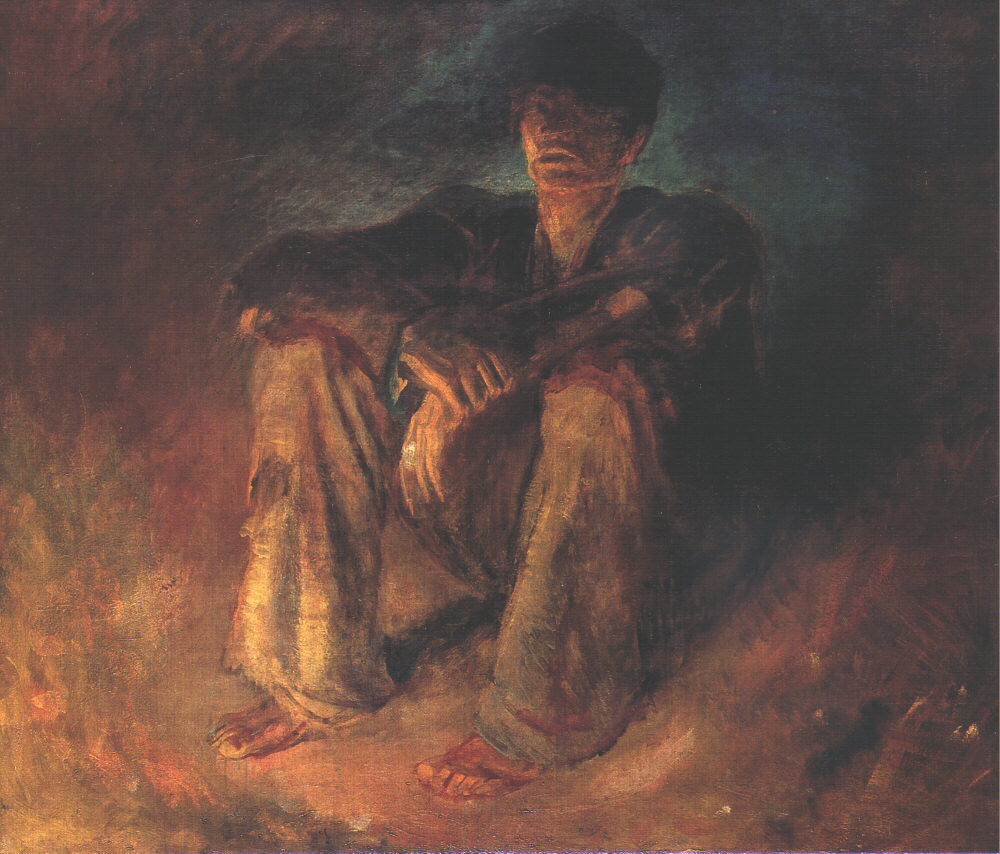
Down and out (1898) László Mednyánszky
At points, we also doubt whether the dreamer is a trustworthy narrator. He consistently warns us of his own capacity for embellishment and during an emotional confession admits ‘I remember that I so wanted to make myself break out into laughter, because I already felt some inimical little devil in me, and also felt a lump forming in my throat’. He is someone for whom, potentially, life experience serves as little more than‘ narrative material’ for his fantasies(2). This revelation lays bare the temptations of an overdeveloped imagination, as we see the simultaneous shallowness and depth of the dreamer’s life. He may be convinced of experiencing heightened emotion, but perhaps his sentimentality is magnified. The piece feels like Dostoyevsky’s musings on his own mind. Is this the sacrifice the artist must make to accurately capture and project emotion?
Why write about this short story? It was recommended by a close friend of mine who knows me well enough for me to listen and read. I am lucky to have such friends (3). Similarly, to our character (and virtually all of humanity), I recently encountered a situation where future hopes melted away.
Afterwards, I fell into a strange and dream like cycle of sadness and lamentation. Breakups suck, fundamentally.The strange part for me was that I anticipated the end, and rather than attempt to resolve or clarify the situation, I was resigned to cursing fate. I was thrown me into a strange psychological wilderness. How had my predictions about the future been so wrong? Were my illusions and my inability to realise or correct them a product of naivety or narcissism? I became increasingly frustrated and withdrew into nostalgic memories, a dangerous form of medicine.
At times in my life, I felt as though my emotional depth was magnified. In the past it seemed to serve me well, allowing me to engage more meaningfully with literature and art. This time it seemed like a curse, drawing me out of reality into dark and compelling fantasy.
The dreamer provided for me an insightful framework for exploring my own melancholic tendencies. Maybe Plato was right, tragedy is a vice (4). It warps our perceptions and encourages us to be tragic hero’s rather than virtuous citizens. Our lives are consistently supplying material for sentimental narratives. The danger comes when our dramatized inner world running on abstract exaggerations of reality, becomes more compelling than real life. It becomes easier to wallow in our own reveries than reconstruct shattered hopes.
As for Dostoyevsky’s message, I think it’s more subtle. White Nights teaches us that our conceptions, conclusions, even our art, must be rooted in the fertile soil of reality.We must continue to wander and dream, but to do so at our own peril.
References:
[1] Terras, V. (1964) ‘Problems of human existence in the works of the young dostoevsky’,Slavic Review, 23(1), pp. 79–91. doi:10.2307/2492377.
[2] Rosenshield, G. (1977) ‘Point of view and the imagination in Dostoevskij’s “White nights”’,The Slavic and East European Journal, 21(2), p. 191. doi:10.2307/306699.
[3] ZK
[4] ‘Book III, Book X’, inPlato’s Republic.